Climate Change
Introduction
As part of leadership of the G8 in 2005, the UK government has
made a concerted effort to establish consensus amongst scientists
on what constitutes ‘dangerous’ climate change www.stabilisation2005.com.
Evidence indicates that only drastic cuts in global emissions of
CO2, of two-thirds or more, can stave off ever more severe climate
change. The more quickly the world can make such cuts, the lower
the level at which concentrations will eventually stabilise. Business
has a crucial role to play.
Climate Change impacts biodiversity by changing phenology, physiology
and distribution of species as well as causing in situ adaptations
to populations. In turn, predation and competition within ecosystems
results in changes to community structures.
Climate change and sea level rise raise some fundamental questions
about the objectives of, and approaches to, nature conservation
in the UK. The Department of Environment, Food, and Rural Affairs
(DEFRA) supports a number of projects designed to research, assess
and make policy recommendations on the effects of climate change
on the UK Biodiveristy Action Plan (UKBAP). In addition, numerous
regional and local initiatives have also been started, such as the
UK Climate Change
Impacts Programme (UKCIP), Environmental
Change Institute (ECI) and The
Wildlife and Countryside Link Biodiversity Task Force. For business,
there are implications for the development of Company Biodiversity
Action Plans, as well as the long term sustainability of biodiversity
initiatives.
The wide range of issues surrounding the debate on Climate Change
provides a challenge for companies in terms of understanding their
roles, responsibilities, risks and opportunities in relation to
this complex topic. With the UK’s Government’s role
in leading the G8 summit and presidency of the European Union in
2005, Climate Change has been placed firmly on the political agenda.
Companies increasingly need to understand the implications that
this agenda has on their businesses.
Green House Gases (GHGS) and Climate Change
Before the industrial age, the carbon dioxide (CO2) level was steady
at around 280 parts per million (ppm). When the Kyoto protocol was
drawn up in 1997, the CO2 level had reached 368 ppm. In 2004, it
hit 379 ppm. Experts predict that if CO2 concentrations rise to
concentrations of 550 ppm, this will probably result in a global
temperature rise of 2°C to 5°C, and a sea level rise of
0.3 to 0.8 metres by 2100, and by 7 to 13 metres over the next millennium.
(A range of statistics pertaining to Climate Change science is available
from the Intergovernmental Panel on Climate Change (IPCC)).
Impacts of Climate Change on Biodiversity
The implications of climate change on biodiversity are extensive,
affecting not only individual species, but entire ecosystems and
the way in which these are managed.
Shifts in distribution of plants and animals
At the simplest level, changing patterns of climate will alter
the natural distribution limits for species or communities. In the
absence of barriers it may be possible for species or communities
to migrate in response to changing conditions. Vegetation zones
may move towards higher latitudes or higher altitudes following
shifts in average temperatures. Movements will be more pronounced
at higher latitudes where temperatures are expected to rise more
near the equator.
In most cases natural or man-made barriers will impact the natural
movement of species or communities. Arctic tundra and alpine meadows
may become squeezed by the natural configuration of the landscape,
while these and many other natural systems may be further confined
by human land-use patterns. Many national parks and protected areas
are now surrounded by urban and agricultural landscapes, which will
prevent the migration of species beyond their boundaries.
Changing patterns of precipitation and evaporation
Rainfall and drought will also be of critical importance. Extreme
flooding will have implications for large areas, especially riverine
and valley ecosystems. Increasing drought and desertification may
occur in tropical and sub-tropical zones, and at least one model
has predicted the drying out of large parts of the Amazon.
Rapid changes
Rates of climate change and species adaptation will also be important,
and these will vary at regional and even local levels. The maximum
rates of spread for some sedentary species, including large tree-species,
may be slower than the predicted rates of change in climatic conditions
leading to localised extinctions of these species.
Species interaction
In many cases further complications will arise from the complexity
of species interactions and differential sensitivities to changing
conditions between species. Certain species may rapidly adapt to
new conditions and may act in competition with others.
Shifting seasons
Changes in seasons are already being noticed in many temperate
regions. Birdsong is being reported earlier and spring flowers are
emerging when it was once winter. In agricultural landscapes changes
in the length of growing seasons may improve productivity in mid-latitudes
and increase the potential for arable crops at high latitudes. Negative
impacts may include increased ranges of insect pests and diseases,
and failure of crops in some regions from drought or flooding.
The coastal margins
On coastal margins, especially where these are backed by areas
of intense human use, rising sea levels may lead to the squeezing
out of important coastal habitats.
Warmer oceans
Rising sea temperatures will further affect the distribution and
survival of particular marine resources. Corals have already shown
an extremely high sensitivity to minor increases in temperature.
Chemical effects
In addition to causing a warming effect, increased concentrations
of atmospheric carbon dioxide are known increase rates of photosynthesis
in many plants, as well as improving water use efficiency. In this
way the climate changes may increase growth rates in some natural
and agricultural communities.
Responses to Climate Change
Over time, every individual and organisation will be affected either
by unchecked climate change, or by the mechanisms adopted by business,
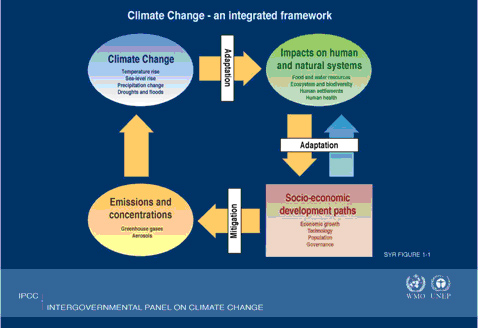
government and civil society. Mitigating and adapting to the effects
of Climate Change will require an integrated approach, such as working
through partnerships. An integrated framework is represented by
the Intergovernmental Panel on Climate Change below.
 Conventions
and Regulation Conventions
and Regulation
The Kyoto Protocol seeks to reduce Carbon Dioxide
emissions by 5.2 % on 1990 levels by between 2008 – 2012.
The EU as a whole also has a commitment to reducing emissions by
8% within that timeframe. The UK has a commitment to reducing their
emissions by 12.5 % within that timeframe.
Within the UK, the Climate Change Levy is applied to all non-domestic
energy use. However, a company is eligible for an 80% rebate on
the levy if it meets its own voluntarily set targets for the 2008
-12 timeframe, if it chooses to sign up to the UK Emissions Trading
Scheme.
Emissions Trading and Sustainable Development
There are four emerging carbon markets – at the international
level (led by the Kyoto protocol), within the EU, within the US
and the voluntary carbon markets. The shape of these markets and
how they relate to one another is still to be consolidated, but
it is clear that companies are well advised to become informed now,
so that they can make the most of emerging opportunities in the
voluntary carbon markets, and avoid risks that regulatory changes
in national legislation may bring.
The EU Emissions Trading Scheme essentially links the national
commitments of EU member states to the international marketplace
governed by the United Nations Framework Convention on Climate Change
(UNFCCC); it is an open market for the buying and selling of allowances.
Joint Implementation under the Clean Development Mechanism (CDM)
is a system whereby investment in Sustainable Development projects
amongst a set of agreed developing countries can result in winning
further ‘allowances’ that can then be bought and sold
on the open market.
Contributions to sustainable development can also be made by companies
that choose to participate in voluntary carbon sequestration projects.
Independently verified carbon sequestration projects that have not
yet gained approval from the UNFCCC, may still bring value to a
company through the voluntary markets (e.g. Future Forests working
in collaboration with the Edinburgh Centre for Climate Change ).
Climate Change, Business & Biodiversity
There are a range of projects that companies support through Earthwatch’s
field research portfolio including Arctic tundra carbon dioxide
production; Desertification; Ecosystem interdependence; Carbon sequestration;
Biodiversity distribution; and Species responses.
The level of risk that climate change poses for the business community
depends upon
• Regulations; Effectiveness of International Treaties (Kyoto
and the Clean Development Mechanism)
• Science and Technology innovations (Hydrogen Economy and
Fusion Energy)
• Business mitigation strategies (Increased efficiency of
products)
• Human consumption growth (Depends on population growth and
politics)
• Clarification of predictive models and development of appropriate
management strategies (Depends upon depth and application of scientific
research)
Resources
Carbon
Trust
ClimateCare
Climate
Leaders (US)
Defra
- Business and Climate Change
Edinburgh
Centre for Climate Change (ECCM)
Environmental
Change Institute (ECI)
European
Union Greenhouse Gas Emission Trading Scheme (EU ETS)
Future
Forests
Intergovernmental
Panel on Climate Change (IPCC)
UKCIP
United Nations
Framework Convention on Climate Change (UNFCCC)
United Nations
Environmental Program - World Conservation Monitoring Centre (UNEP-WCMC)
Photo Credits: Iceberg, H Russell, Intergovernmental
Panel on Climate Change (IPCC)
|